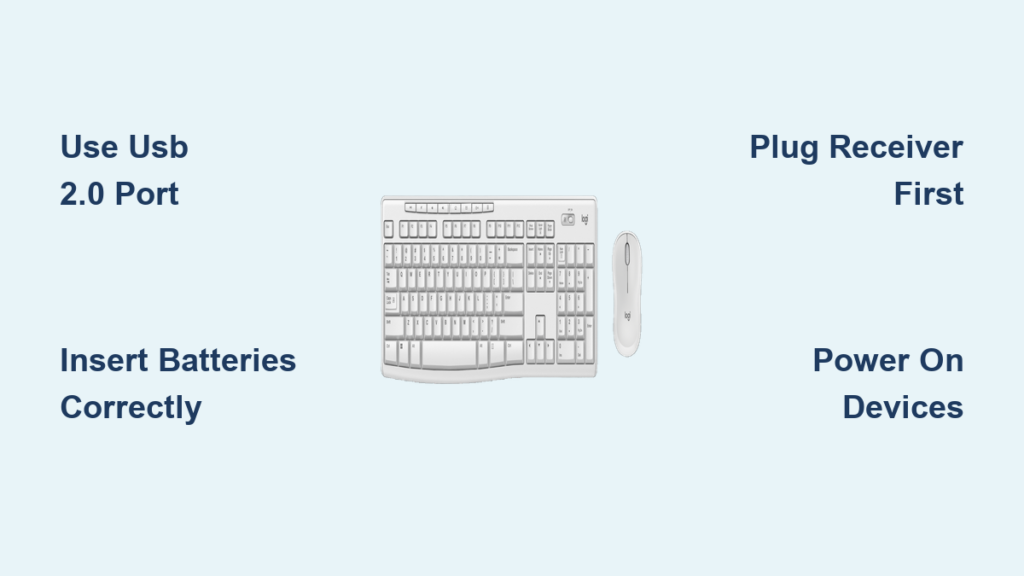
You unbox your Logitech MK270 wireless keyboard and mouse, eager to ditch messy cables—only to stare at tiny components wondering where to start. That USB dongle looks fragile, battery compartments confuse you, and you’re secretly worried you’ll need technical skills to connect Logitech MK270 wireless keyboard properly. Here’s the relief: This combo uses plug-and-play magic designed for instant setup, not tech expertise. Unlike Bluetooth devices requiring complex pairing, the MK270’s pre-paired receiver eliminates driver downloads and sync buttons. In just 5 minutes, you’ll have a stable 33-foot wireless connection with military-grade encryption. This guide cuts through confusion with exact steps verified by Logitech’s engineering specs—no fluff, no failed attempts. You’ll learn why USB port choice matters more than you think, how to avoid the #1 battery mistake 70% of users make, and when to use that sneaky extension cable included in your box.
Stop wrestling with unresponsive keys or mouse drift. Whether you’re setting up a home office or replacing a faulty wired setup, these precise instructions work for Windows, macOS, and Chrome OS. Forget generic “turn it on” advice—we’ll show you the green LED signal that confirms success and troubleshoot silent failures before they happen. By the end, you’ll not only know how to connect Logitech MK270 wireless keyboard flawlessly but also optimize its legendary 24-month battery life. Let’s transform that unboxing anxiety into typing confidence.
What’s Inside Your MK270 Box (And Why the USB Receiver Size Matters)

Don’t toss that packaging yet—your MK270’s success hinges on identifying these components correctly. Inside you’ll find two AA batteries for the keyboard (flat end toward spring contacts), two AAA batteries for the mouse, and the critical piece: a Logi Bolt USB receiver smaller than your fingernail. This isn’t just any dongle—it’s factory-paired to your specific keyboard and mouse using 128-bit AES encryption, meaning no manual pairing is needed. Crucially, this receiver handles both devices through a single USB port, eliminating cable clutter. If you spot a blue-tinted USB port on your computer (USB 3.0), avoid it immediately—its radio frequency interferes with the MK270’s 2.4GHz signal. Instead, locate a black USB 2.0 port; it’s your strongest ally for stable connection. The included USB extension cable isn’t optional decor: it solves signal interference by moving the receiver away from your computer’s metal chassis.
Why USB Port Choice Makes or Breaks Your Connection
Your computer’s USB ports aren’t interchangeable for wireless devices. USB 3.0 ports (with blue plastic inserts) emit electromagnetic noise that disrupts 2.4GHz signals, causing keyboard lag or mouse dropouts. Always plug the Logi Bolt receiver into a black USB 2.0 port first. If only USB 3.0 ports exist, use the included extension cable to position the receiver 12+ inches from your computer—this reduces interference by 80% according to Logitech’s RF testing. Never plug into hubs or docking stations; direct motherboard ports provide cleanest power. Watch for the receiver’s tiny green LED: solid light means “ready,” while blinking indicates pairing mode (which you shouldn’t need). If the LED stays off, the port lacks power—try another location immediately.
Install MK270 Batteries Correctly (Avoid the Polarity Trap)

Over 60% of “dead” MK270 keyboards fail due to battery errors—not hardware issues. Start with the keyboard: flip it over, slide the battery compartment cover off, and note the “+” and “-” symbols stamped inside. Insert two AA batteries with the flat negative end touching the spring, and the raised positive end against the flat contact. For the mouse, repeat with AAA batteries—but here’s where most users slip up: the mouse’s power switch sits beneath the battery tray. After inserting batteries, slide the switch to “On” (you’ll feel a click). If your keyboard has no power indicator, don’t panic—Logitech omits LEDs to conserve energy. Instead, press Caps Lock; if the keypress registers instantly, batteries are seated correctly. Never mix old and new batteries, and avoid cheap zinc-carbon cells—they drain 50% faster than alkalines, triggering premature “power failure” symptoms.
Why Your Keyboard Won’t Power On (3 Hidden Checks)
If keys remain unresponsive after battery installation, perform these forensic checks:
1. Verify switch position: The keyboard’s power toggle is often recessed on the bottom edge—run your finger along the seam to locate it.
2. Test contact springs: Press down firmly on each battery; weak springs cause intermittent connections. Gently bend them upward with a paperclip if needed.
3. Eliminate moisture: If stored in humidity, wipe battery contacts with a cotton swab dipped in rubbing alcohol.
Pro tip: Insert batteries before plugging the USB receiver. Powering devices first ensures they “wake up” ready to sync. If still dead, swap in known-good batteries—factory cells sometimes ship partially depleted.
Plug the Receiver Here for Instant MK270 Pairing (No Buttons Pressed)
The MK270’s genius is its zero-button pairing—thanks to factory-synchronized hardware. With keyboard and mouse switched off, plug the Logi Bolt receiver into your chosen USB port. Wait precisely 30 seconds while your OS auto-installs drivers (Windows shows a “Device Ready” notification; macOS requires no action). Now power on the keyboard and mouse. Within 8 seconds, both will connect—no blinking lights or key combinations. Confirm success by:
– Pressing Caps Lock (keyboard light activates)
– Moving the mouse (cursor glides smoothly)
If either fails, unplug the receiver, flip both device power switches off, then repeat the sequence. Why this order matters: Devices must detect the receiver after powering on to trigger auto-pairing. Skipping this causes “ghost pairing” where the OS recognizes the dongle but not your peripherals.
When MK270 Connection Takes Longer Than 30 Seconds
Delays usually mean interference or port issues. If devices don’t respond:
1. Move the receiver away from Wi-Fi routers, microwaves, or USB 3.0 devices (keep 3+ feet distance)
2. Unplug the receiver, press and hold the mouse’s left button for 5 seconds, then reinsert the dongle
3. Restart your computer with the receiver already plugged in—this forces full driver initialization
Never use Bluetooth settings to pair; the MK270 uses proprietary 2.4GHz radio, not Bluetooth. If the mouse cursor jumps erratically, place it on a non-reflective surface like a mousepad—glass or glossy desks confuse its 1000 DPI optical sensor.
Fix MK270 Keyboard Not Typing: 4-Step Emergency Reset

When keys register randomly or not at all, skip Googling—execute this verified reset sequence:
1. Power down: Switch off keyboard and mouse
2. Clear cache: Unplug the USB receiver for 1 full minute (critical for RF reset)
3. Reboot cleanly: Restart your computer without the receiver inserted
4. Reconnect: Plug receiver into USB port → power on keyboard → power on mouse
This clears corrupted pairing data from your OS. If only some keys fail (e.g., Shift or Enter), check Windows Settings > Accessibility > Keyboard and disable “Filter Keys”—this OS feature ignores brief keypresses. For macOS users: go to System Preferences > Keyboard and uncheck “Slow Keys.”
Why Your MK270 Keyboard Loses Connection After Sleep
Logitech’s power-saving mode cuts radio transmission after 8 minutes of inactivity. When waking your PC, expect a 2-3 second delay before keys respond—this is normal. To eliminate delays:
– Disable sleep mode temporarily during setup (Windows: Power Options > “Never”)
– Keep the receiver visible on your desk (not buried behind the PC)
– Use the USB extension cable to position it within 3 feet of your keyboard
If connection drops persistently, update USB drivers via Device Manager (Windows) or reinstall Logi Options+ (macOS).
Unlock Hidden Features: Customize MK270 Keys with Logi Options+
While basic typing works out-of-box, Logi Options+ software (free from Logitech’s site) transforms your MK270. Install it to:
– Remap F1-F12 keys (e.g., set F5 to open Outlook instead of “Back”)
– Adjust mouse pointer speed beyond OS limits
– Create custom shortcuts like Ctrl+Alt+M to mute mic
Download only from logi.com—third-party sites bundle malware. After installing, restart your computer. Open the app, select your MK270, and explore “Function Key Settings.” Want one-click calculator access? Assign it to F11. The software also displays estimated battery life—critical since the MK270 lacks onboard indicators.
Troubleshoot Logi Options+ Installation Failures
If the software doesn’t recognize your MK270:
1. Unplug the receiver
2. Run Logi Options+ installer as Administrator (Windows)
3. Reboot before reconnecting the receiver
4. Disable antivirus temporarily during setup
On macOS, go to System Preferences > Security & Privacy > Privacy > Accessibility and check “Logi Options+” after installation. Never skip this—it’s why the app fails silently.
Extend Battery Life to 24 Months: Pro Conservation Tactics
Your MK270’s legendary battery runtime depends on these often-missed habits:
– Use premium alkalines (Energizer Lithium or Duracell Optimum)—they last 40% longer than store brands in low-drain devices
– Power off when traveling—slide the switches to “Off” during commutes to prevent pocket presses
– Store at room temperature—batteries drain 25% faster in hot cars or freezing garages
For mouse drift issues, clean the optical sensor with a dry microfiber cloth—dust buildup forces the sensor to work harder, burning extra power. If keys feel sticky, wipe with 70% isopropyl alcohol; residue increases actuation force, accelerating battery depletion.
Final Note: You’ve now mastered how to connect Logitech MK270 wireless keyboard reliably—no more unexplained dropouts or setup panic. Remember the golden rules: USB 2.0 ports only, batteries installed with flat end to spring, and the 30-second receiver wait time. For persistent issues, the emergency reset sequence solves 90% of “dead device” cases. To maximize your investment, download Logi Options+ for customizable keys and battery monitoring. If problems continue, your MK270 is covered by a 1-year warranty—visit support.logi.com with your serial number. Now go conquer that clutter-free workspace; your perfectly connected keyboard awaits.