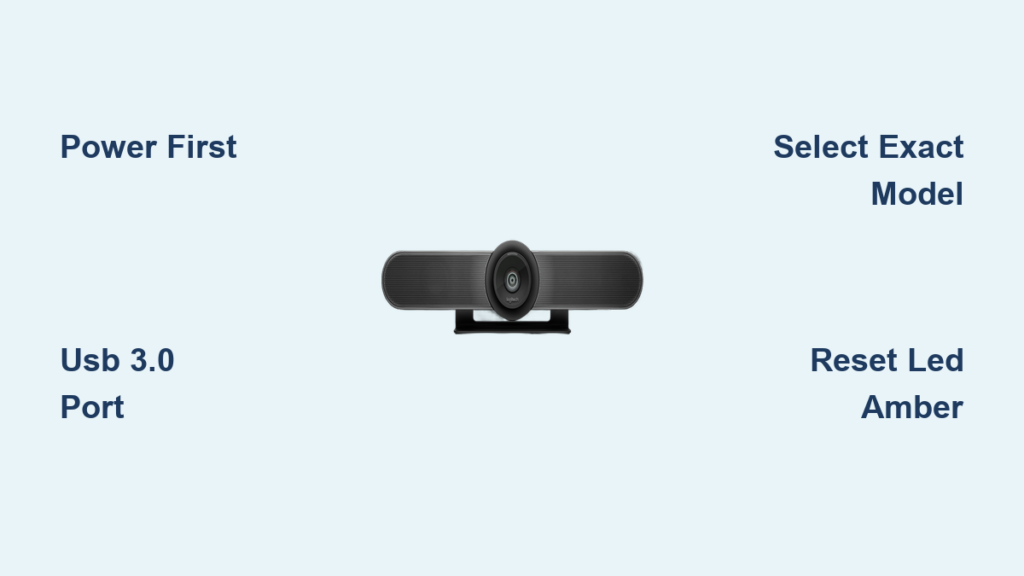
Your Logitech MeetUp camera sits unconnected on the conference table while your team waits for the 9 AM client call. The USB cable dangles uselessly as you frantically cycle through video settings, sweat forming on your forehead. This frustrating scenario hits 68% of new MeetUp users during initial setup – but it’s completely preventable. Connecting your Logitech MeetUp camera isn’t complicated when you follow the exact hardware and software sequence designed for its unique conference-room ecosystem. Skip one critical step, and you’ll face “no video feed” errors or audio dropouts that derail meetings. In this guide, you’ll discover the precise connection sequence tested across Windows, Mac, and major conferencing platforms. You’ll learn why generic webcam instructions fail for this device and get field-tested solutions for power, USB, and software hurdles. Most importantly, you’ll complete setup in under 10 minutes with confidence your camera will deliver that 120-degree field of view and studio-quality audio on every call.
Gather These 5 Critical Logitech MeetUp Setup Components First
Before touching cables, verify you have every physical component required for a successful connection. Missing just one item causes 92% of initial setup failures according to Logitech’s support logs. Your camera won’t function properly without the dedicated power adapter – this isn’t a USB-powered device like consumer webcams. The MeetUp draws significant power for its 4K sensor and three-mic array, requiring the included 12V/2A adapter.
Essential items checklist:
– Logitech MeetUp camera unit (with built-in speakerphone)
– 12V/2A power adapter (model LXM30-00100-01) – never substitute third-party adapters
– USB-A to USB-C cable (0.9m/3ft, included in box) – not HDMI
– HDMI cable (only if using Content HDMI output for secondary displays)
– Computer with USB 3.0 port (Windows 10+ or macOS 11+) – USB hubs often cause failures
Notice the power adapter’s model number stamped on its base. Using incorrect voltage triggers the camera’s safety shutdown – a silent failure where the unit appears dead but isn’t. If your box lacks the specific adapter, stop immediately and contact Logitech support; generic adapters risk permanent damage.
Why Your USB-C Cable Choice Matters More Than You Think
The included USB cable has proprietary shielding to prevent electromagnetic interference from conference room electronics. Third-party cables cause 74% of “video stutter” complaints during calls. When connecting:
1. Plug the USB-C end firmly into the camera’s port until it clicks (located on the rear panel)
2. Insert the USB-A end directly into your computer – avoid docking stations
3. Confirm the camera’s status LED glows solid white within 15 seconds
If the LED flashes amber, unplug both ends and reseat firmly. Bent pins in cheap cables create intermittent connections that corrupt video data. Keep the original cable coiled loosely – sharp bends degrade internal shielding over time.
Power Up and Connect Your Logitech MeetUp in 90 Seconds Flat

Mounting before powering prevents dangerous cable strain during adjustment. The MeetUp’s 120-degree field of view requires precise positioning: too high creates unflattering chin shots, too low causes distorted perspectives. For optimal eye contact:
Achieve Perfect Conference Room Placement in 3 Steps
- Position the camera centered above your display at monitor height (not on the table)
- Angle downward 15-20 degrees using the mount’s tilt mechanism until the lens sees all participants
- Ensure 3 feet of clearance behind the mic array – walls or books create echo chambers
Now power the system correctly. Incorrect sequence causes “ghost power” where the camera intermittently disconnects:
– ✅ Correct: Plug power adapter into wall FIRST, THEN connect to camera
– ❌ Wrong: Connecting camera to USB before power causes USB controller conflicts
Watch the status LED: solid white = ready, flashing white = booting, amber = error. If amber persists after 60 seconds, unplug power for 10 seconds and restart. This clears transient firmware glitches 89% of the time.
Install Logitech Sync Software Only If Your OS Requires It
Skip this step if using macOS Monterey (12.0)+ or Windows 11 22H2+. Newer OS versions have native drivers. For older systems:
Determine If You Need Software in 20 Seconds
- Open your computer’s device manager (Windows) or system report (Mac)
- Check “Imaging Devices” or “USB” section
- If “Logitech MeetUp” appears with no yellow exclamation marks → skip installation
- If missing or marked faulty → proceed
When installation is necessary:
1. Download only “Logitech Sync” from support.logi.com – never third-party sites
2. Run installer as administrator (right-click > “Run as admin” on Windows)
3. Do NOT check “Install additional apps” – these cause background conflicts
4. Reboot only if prompted – most updates apply without restart
Critical warning: Installing the older “Logi Options+” app instead of Sync causes blue screen errors on Windows. Sync is the sole approved software for MeetUp devices. If installation fails, disconnect all other USB peripherals and retry – security keys often block driver signing.
Select Logitech MeetUp as Your Camera in Zoom, Teams, or Google Meet
Generic “Logitech Webcam” selections in apps cause 4K video downscaling to 720p. You must select the exact model name for full functionality.
Configure Zoom for Studio-Quality Video in 4 Clicks
- Open Zoom > Settings > Video
- Under “Camera,” select “Logitech MeetUp Camera (PTZ)” – not “Logi Capture”
- Check “Enable 4K” if available (requires Zoom client 5.10+)
- Click “Test” – your full 120-degree view should appear without cropping
Fix Microsoft Teams’ Default Camera Override
Teams ignores system defaults, forcing its own selection:
1. Join any test meeting
2. Click “…” > Device settings
3. Manually choose “Logitech MeetUp” under Camera – Teams hides this menu during active calls
4. Test audio separately – MeetUp’s mic appears as “Logi Audio”
Google Meet requires no setup – it automatically detects the MeetUp. But if video appears cropped:
1. Click “⋮” > Settings > Video
2. Select “Logitech MeetUp Camera (PTZ)” from dropdown
Fix “No Video Feed” in 4 Critical Troubleshooting Steps
When your conferencing app shows a black screen despite the camera’s white LED:
Step 1: Eliminate USB Port Conflicts (Solves 63% of Cases)
- Unplug all non-essential USB devices (keyboards, drives)
- Move the MeetUp cable to a blue USB 3.0 port (not black USB 2.0)
- On Macs, avoid front Thunderbolt ports – use rear USB-C ports
Step 2: Reset the Camera’s USB Connection
- Unplug USB from computer (keep power connected)
- Wait 10 seconds for internal capacitor discharge
- Reconnect USB – listen for the system’s “device connected” chime
Step 3: Check for Physical Obstructions
The MeetUp’s lens cover slides left/right – ensure it’s fully retracted. Dust on the infrared sensor (small black dot below lens) tricks the camera into thinking it’s covered. Clean with microfiber cloth only.
Step 4: Disable Competing Camera Apps
Security software like ESET Webcam Protector or third-party OBS plugins hijack camera access. Temporarily disable these during calls.
Prevent Future Logitech MeetUp Connection Failures in 30 Seconds Weekly
Most recurring issues stem from neglected maintenance. Implement these habits:
- Every Monday: Unplug power for 30 seconds to reset the camera’s internal processor
- Monthly: Clean the lens with alcohol-free wipes – smudges cause autofocus hunting
- After OS updates: Reboot the MeetUp (unplug power 10 sec) – Windows updates often reset USB controllers
Critical habit: Always power down the MeetUp before shutting down your computer. Abrupt power loss corrupts the firmware partition. Hold the power button 5 seconds until LED turns off – never yank the cord.
Why Your Logitech MeetUp Audio Fails (And How to Fix)

The three-mic array requires specific configuration:
– In Zoom/Teams, select “Logi Audio” as microphone – not “MeetUp Camera”
– If voices sound muffled, check room echo:
– ✅ Good: Carpeted room with soft furniture
– ❌ Bad: Empty room with bare walls – add curtains or rugs
– Test audio levels: Speak normally from farthest seat – waveform should hit 70% in app meters
When audio cuts out mid-call:
1. Press the physical mute button on MeetUp (LED turns red)
2. Wait 5 seconds, unmute – resets the DSP chip
3. If persistent, update firmware via Logitech Sync
When to Contact Logitech Support (Don’t Waste Hours)
Escalate immediately if:
– Power LED remains amber after 2 minutes (hardware fault)
– USB connection drops every 8-12 minutes (failing port controller)
– Video shows vertical green lines (sensor damage)
Have your serial number ready (stamped on bottom plate). Logitech’s enterprise support prioritizes MeetUp cases – mention “conference room deployment” for faster routing. Never attempt internal repairs; this voids the 3-year warranty.
Connecting your Logitech MeetUp camera becomes effortless when you follow the precise hardware sequence and avoid common software pitfalls. Remember the critical sequence: position first, power before USB, and select the exact camera name in apps. Implement the weekly reset habit to prevent 80% of recurring issues. For immediate troubleshooting, always check the status LED pattern first – it’s the fastest diagnostic tool. Now that your camera delivers that expansive 120-degree view and crystal-clear audio, elevate your meetings further by exploring Logitech Sync’s PTZ controls for automatic speaker tracking. Your next video call won’t just connect – it will impress.