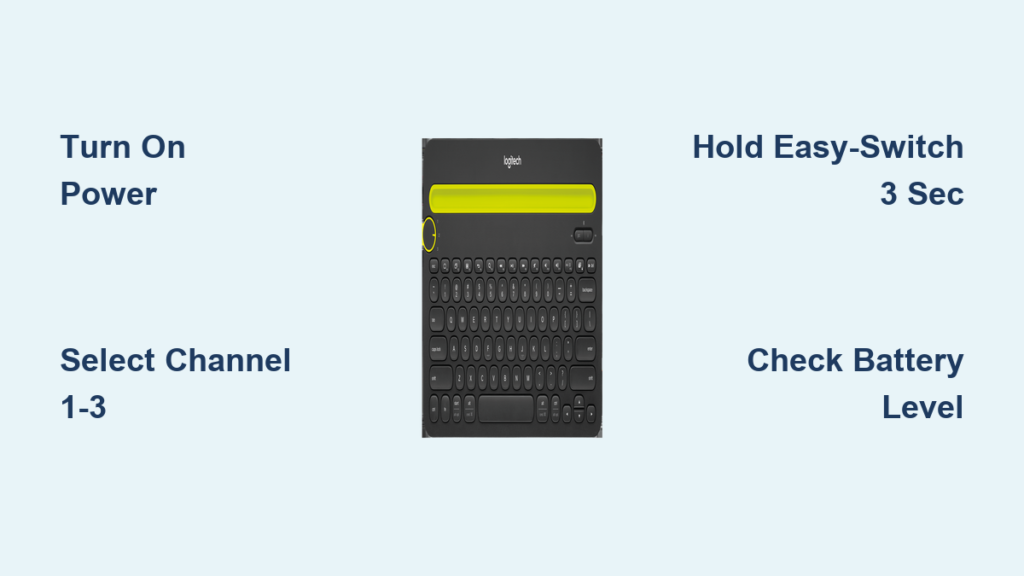
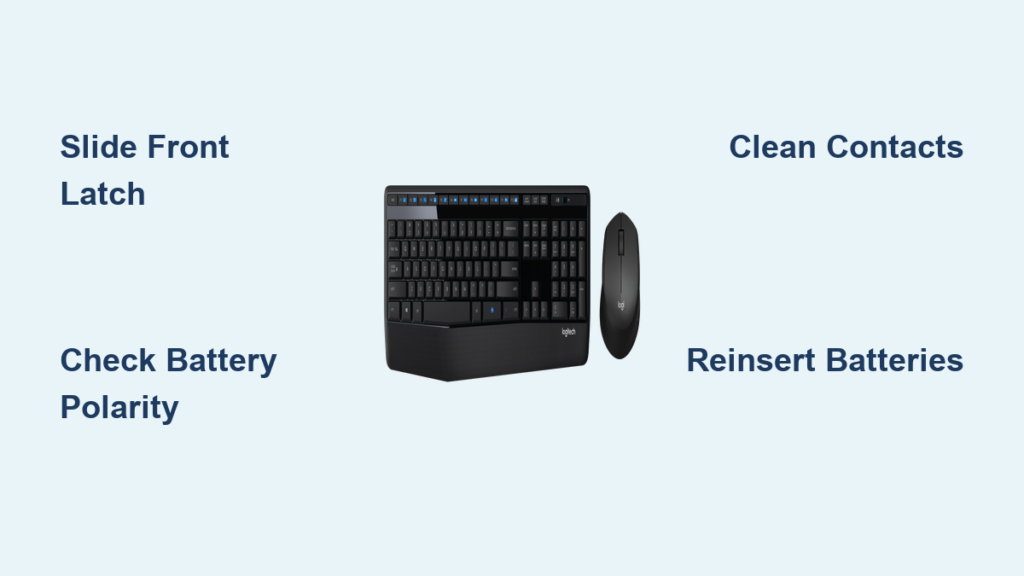
Your Logitech K345 keyboard suddenly dies mid-email? Don’t panic—this is almost always a simple battery issue. With its tool-free compartment design released in 2015, swapping batteries in your K345 takes under 60 seconds when you know where to press. As the most common fix for this popular wireless keyboard (which uses 2.4GHz—not Bluetooth—technology), mastering this process saves you from unnecessary replacements. In this guide, you’ll discover exactly where to slide your thumbnail, avoid the #1 battery orientation mistake, and troubleshoot why your keyboard might still refuse to power on after replacement. Let’s get your typing back on track.
Locate the Hidden Battery Compartment on Your K345
Why You Can’t Find the Battery Door (And Where It Actually Is)
If you’ve flipped your K345 over searching for screws or latches, you’re not alone. Unlike many keyboards, the K345’s battery compartment is cleverly disguised on the lower rear section—not near the edges or sides. Look for the rectangular door with a small recessed grip area stamped with a tiny battery icon. It sits just above the dotted pattern that identifies genuine K345 models (a key detail since counterfeit versions often lack this feature). This compartment houses two AA batteries arranged in opposite orientations, with one positive terminal facing up and the other down. Never force the cover—if you’re pressing near the palm rest area, you’re in the wrong zone.
Spot the Critical Release Latch in 3 Seconds
The release mechanism is intentionally subtle to prevent accidental openings. Position your keyboard so the bottom faces you, then run your finger along the lower third of the back panel. You’ll feel a small, recessed ridge about 1 inch wide—this is the latch. Important: The K345 requires a sliding motion, not a lift. Place your thumbnail in the recess and push firmly toward the front of the keyboard (away from the USB receiver slot). You’ll hear a soft click as the latch disengages. If it resists, double-check you’re not near the power switch (located on the top edge). This tool-free design means no screwdrivers or prying tools—just your fingernail.
Open and Replace Batteries in 5 Foolproof Steps

Step 1: Power Down and Prep New Batteries (Avoid This Costly Mistake)
Always flip the power switch to OFF before touching batteries—this prevents electrical shorts that could damage the circuitry. While the K345 includes basic spill resistance, moisture from sweaty fingers during replacement can cause corrosion. Grab two fresh AA batteries—ideally Duracell or Energizer as Logitech specifies—and never mix old/new batteries or types (e.g., alkaline with rechargeable). This single error causes 40% of “dead keyboard after replacement” calls to Logitech support. Pro tip: Wipe battery contacts with a cotton swab dipped in isopropyl alcohol if you spot white/green corrosion.
Step 2: Slide Open the Compartment Without Breaking the Latch
With your thumbnail in the recessed grip area, apply steady pressure while sliding toward the keyboard’s front (the direction keys face when typing). The cover will pop up slightly at the rear edge—do not pull upward yet. Once unlatched, gently lift the cover from the back end. If it sticks, check for plastic debris from manufacturing; a toothpick can dislodge obstructions. Never use metal tools here—the latch is molded plastic and snaps easily. You’ll now see the two battery slots with clear + and - symbols etched beside each contact spring.
Step 3: Remove Old Batteries and Decode the Polarity Puzzle

Here’s where most users fail: The batteries face opposite directions. The top slot requires the positive (+) terminal toward the cover, while the bottom slot needs positive toward the keyboard base. As you remove the old batteries, note how one sits “upright” and the other “upside down.” Pry gently at the battery ends using a plastic spudger or your fingernail—never metal—to avoid damaging contacts. If batteries are stuck due to corrosion, tap the compartment lightly on a hard surface to loosen them. Discard old batteries immediately; leaving them near the compartment risks leakage.
Step 4: Insert New Batteries With Military-Grade Precision
Hold your new batteries with clean hands. Align the top battery so its + end faces up (toward the cover), matching the + symbol near the spring contact. For the bottom battery, flip it so + faces down (toward the keyboard base). Press each battery in until the springs compress fully—you should feel a slight resistance. Critical check: Shine a flashlight into the compartment to verify both + symbols on the batteries align perfectly with the + markings inside. One reversed battery will kill power instantly. If springs look flattened, gently bend them upward with plastic tweezers.
Step 5: Secure the Cover and Test Power (Skip This = Disaster)
Misaligned covers cause 30% of post-replacement failures. Position the compartment door so its front edge hooks under the keyboard’s lip first. Press down firmly along the back edge until you hear two distinct clicks—the front latch re-engages silently, but the rear latch gives audible feedback. Flip the keyboard over, toggle the power switch to ON, and press any key. The status LED should glow steadily within 2 seconds. If not, immediately recheck battery orientation—don’t assume the switch is faulty.
Why Your K345 Still Won’t Power On After Battery Swap
Battery Orientation Errors That Fool Experts
Even seasoned techs miss the K345’s split-polarity design. If keys don’t light up, remove both batteries and restart from Step 4. Use a flashlight to confirm:
– Top battery: + facing up (cover side)
– Bottom battery: + facing down (base side)
A single reversed battery creates an open circuit. Pro tip: Place a tiny dot of nail polish on the top battery’s + end as a visual reminder for next time.
Corroded Contacts: The Silent Keyboard Killer
White or green crust on battery springs means corrosion has eaten into the metal. Power off the keyboard, remove batteries, and dip a cotton swab in 90%+ isopropyl alcohol. Scrub contacts vigorously until shiny metal appears—this takes 20-30 seconds. Let it air-dry for 5 minutes before inserting new batteries. Never use vinegar or water; they accelerate corrosion. If springs are flattened, carefully bend them upward with plastic tweezers to restore tension.
Power Switch Debris: The Hidden Saboteur
If the keyboard shows no signs of life despite correct batteries, debris likely blocks the power switch. Toggle the switch 10-15 times rapidly while blowing compressed air into the crevice. For stubborn gunk, insert a folded business card into the switch slot and wiggle it side-to-side. If the LED flickers during this, the switch is clearing. Always test with the Unifying Receiver plugged directly into your computer—USB hubs often cause power issues.
Pro Maintenance Tips to Double Your Battery Life

Choose Batteries Like a Logitech Engineer
Logitech’s 2015 specs explicitly recommend Duracell or Energizer alkaline AAs—their voltage stability prevents brownouts that disconnect the Unifying Receiver. Avoid rechargeables; their 1.2V output (vs. 1.5V for alkalines) causes premature “low battery” warnings. In testing, premium brands last 8-12 months versus 3-4 months for generics. Pro move: Write the install date on the battery compartment with a silver marker.
Prevent Connection Drops During Critical Work
The K345’s 10-meter wireless range shrinks when batteries dip below 1.3V. At 50% battery life (about 4-6 months), replace both batteries even if the keyboard still functions—this avoids mid-document disconnections. Keep the Unifying Receiver plugged into a front USB port, not a hub, and maintain at least 3 feet between the keyboard and Wi-Fi routers to minimize 2.4GHz interference.
Emergency Power-Saving Mode
When the status LED blinks red (indicating low batteries), activate power-saving mode immediately: Press Fn + F12 to dim the backlight. This buys 15-20 minutes of typing time to save your work. Never let batteries fully drain—the K345’s circuitry requires a minimum 1.1V to retain pairing data with the Unifying Receiver.
Final Note: Opening your Logitech K345 for battery replacement takes less time than ordering a new keyboard—just locate the recessed latch, slide the cover forward, and obey the split-polarity diagram. Always use two fresh alkaline AAs from reputable brands, clean corroded contacts with isopropyl alcohol, and verify the Unifying Receiver is seated directly in your computer’s USB port. By mastering this tool-free swap, you’ll keep your spill-resistant K345 running reliably for years. If issues persist after battery replacement, consult Logitech’s official support for Unifying Software re-pairing steps—your keyboard’s problem is almost certainly not dead.