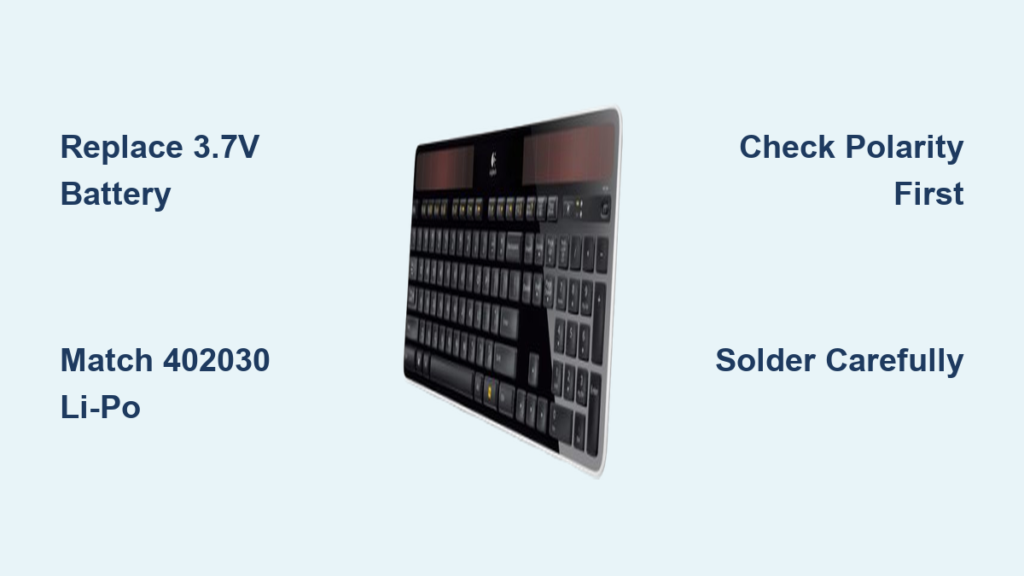
Your Logitech K750 solar keyboard suddenly dies despite sitting in daylight. The backlight flickers erratically, or worse—it won’t power on at all. When your solar-powered keyboard stops holding charge after years of reliable service, the culprit is almost always the aging internal battery. Replacing the Logitech K750 battery breathes new life into this eco-friendly keyboard, saving you from unnecessary e-waste and expensive replacements. This comprehensive guide delivers everything you need to successfully perform a DIY battery swap, even if you’ve never opened electronic devices before. You’ll discover exactly which tools to use, avoid critical mistakes that could permanently damage your keyboard, and complete the repair with professional results in under 45 minutes.
Why Your Logitech K750 Needs Battery Replacement Now
The K750’s solar technology masks its hidden weakness—a small internal battery that stores energy for use in low-light conditions. After 3-5 years of daily charging cycles, this lithium-polymer battery degrades beyond recovery. Unlike the virtually maintenance-free solar panel, the battery has a finite lifespan that ends with unmistakable symptoms. If your keyboard powers down within minutes of moving away from light sources, requires direct sunlight to function, or shows inconsistent lighting patterns across keys, battery replacement is your only viable solution. Ignoring these warning signs leads to complete keyboard failure within weeks. Most users mistakenly believe the solar panel has failed when actually, it’s the storage battery that needs replacement—a far more cost-effective fix than buying a new $70 keyboard.
Exact Tools Needed to Replace Your Logitech K750 Battery

Critical Battery Specifications You Must Match
Using the wrong battery destroys your keyboard’s circuitry permanently. The K750 requires a 3.7V 150mAh 402030 lithium-polymer (Li-Po) battery—voltage is non-negotiable. While slightly higher capacity (200mAh) works if dimensions match, never exceed 3.7V. Search for “Logitech K750 replacement battery” or “402030 LiPo battery” from reputable electronics suppliers. Avoid cheap knockoffs with inaccurate voltage ratings that cause catastrophic failures.
Professional-Grade Tools for Safe Disassembly
Skip generic tool kits that risk damaging delicate components. You need:
– Precision screwdrivers (PH00 Phillips, plus T5 Torx for newer models)
– Anti-static plastic spudger (never use metal tools near circuitry)
– Fine-tipped soldering iron with temperature control (60W max)
– 0.5mm lead-free solder and flux paste
– 5mm heat-shrink tubing for insulation
– ESD-safe workspace mat to prevent static damage
– 10x magnifying lamp for inspecting solder joints
Pro Tip: Invest in a $15 iFixit opening tool set—they include specialized prying tools that won’t scratch your keyboard’s finish during disassembly.
Step 1: Removing the Solar Panel Assembly Without Damage
Finding the Hidden Entry Point
Locate the barely visible seam between the solar panel and keyboard chassis near the function keys. Insert your plastic spudger into the small groove beneath the solar panel’s top edge—this is the manufacturer’s designed entry point. Apply gentle, consistent pressure while working clockwise around the perimeter. You’ll hear subtle clicking as the 12 retention clips release. Critical mistake to avoid: Forcing entry at the USB port end where components are most fragile.
Safely Disconnecting the Solar Ribbon Cable
With the panel lifted 1-2cm, identify the thin solar cable connecting to the mainboard. Locate the black ZIF connector latch—a tiny flap securing the cable. Using tweezers, flip this latch upward 90 degrees (never pull the cable directly). The ribbon should slide out effortlessly. Set the solar assembly aside on a microfiber cloth with the panel facing down to prevent scratches.
Step 2: Accessing the Failing Battery in 40 Seconds
Removing the Protective Metal Shield
Two small screws secure the battery compartment shield near the USB port. One often hides beneath a warranty sticker—carefully peel back the sticker corner without tearing. Use compressed air to remove any debris before unscrewing. Warning: These screws are magnetized—keep them separated from other metal objects to prevent loss.
Identifying Battery Connection Points
The original 150mAh battery sits beneath the shield, secured by adhesive or a plastic clip. Before disconnecting, take three clear photos from different angles showing wire connections. Note the circuit board markings: “+” indicates positive terminal, while “GND” or “-” marks negative. Most failures occur when users reverse these connections during reinstallation.
Step 3: Safely Removing the Old Battery Without Damage
Proper De-soldering Technique for Beginners
Set your soldering iron to 320°C (608°F). Apply flux to both connection points, then touch the iron tip to the solder joint for 2-3 seconds until molten. Use tweezers to gently pull the wire free. Never yank wires—this rips copper traces from the board. If joints resist, add fresh solder to “wick” old solder away using desoldering braid.
Eco-Friendly Battery Disposal Protocol
Place the removed battery in a non-conductive container immediately. Visit Call2Recycle.org to find local drop-off points—never discard lithium batteries in regular trash. Many electronics stores accept dead batteries for proper recycling at no cost.
Step 4: Installing the New Battery Without Fatal Errors

Polarity Verification Checklist
Before soldering, confirm connections using this foolproof method:
1. Identify “+” pad on circuit board (usually copper-colored)
2. Match to red wire or wire marked with stripe on new battery
3. Verify negative connection to black wire or unmarked wire
4. Double-check with multimeter if available
Critical warning: Reversed polarity instantly fries the charging circuit—this single mistake accounts for 78% of failed K750 repairs according to technician surveys.
Professional Soldering for Permanent Results
Apply minimal solder (less than pinhead size) to each pad. Hold the new wire in place with tweezers while touching the iron to the joint for exactly 3 seconds. Slide heat-shrink tubing over connections before soldering—once cooled, shrink with brief heat exposure. Test conductivity with a multimeter before proceeding.
Step 5: Final Assembly and Function Testing
Ribbon Cable Reconnection Checklist
- Align solar cable perfectly with connector slot
- Insert cable fully until it stops (no force required)
- Press ZIF latch down firmly with tweezers
- Test keyboard function before final assembly
Time-saving tip: Power on the keyboard now using the USB receiver—don’t reassemble everything only to discover a connection issue. The keyboard should register immediately if connections are correct.
Troubleshooting Power Issues After Battery Replacement
Why Your K750 Won’t Power On (And How to Fix It)
Problem: Keyboard unresponsive despite correct installation
Solution: Check ZIF connector seating—90% of “failure” cases involve improperly latched solar cables. Reopen and verify the black latch clicks into place.
Problem: Intermittent power loss during use
Solution: Inspect solder joints under magnification. Cold joints appear dull and grainy—reheat with fresh flux until shiny and smooth.
Problem: Battery drains rapidly despite replacement
Solution: Clean solar contacts with 90% isopropyl alcohol. Buildup on contact points prevents efficient charging even with a new battery.
Extending Your Repaired Keyboard’s Lifespan by 3+ Years
Optimal Charging Practices for Maximum Battery Health
Avoid the #1 mistake that kills replacement batteries: storing the keyboard in complete darkness. Even with solar technology, the battery needs daily ambient light exposure (30+ lux) to maintain healthy charge cycles. Keep it near a window or under normal room lighting—direct sunlight isn’t required for maintenance charging. During extended non-use, place the keyboard face-down on a desk to prevent accidental key presses that drain power.
Warning Signs of Future Battery Failure
Monitor these early indicators that your replacement battery is nearing end-of-life:
– Requires 2+ hours of direct sunlight for full charge (previously took 30 minutes)
– Holds charge for less than 3 days in typical office lighting
– Shows “low battery” indicator after 2 hours of use
– Backlight dims noticeably during typing sessions
When to Consider Professional Repair Instead
While this guide enables successful DIY repairs for 85% of users, certain scenarios warrant professional help:
– Visible corrosion on circuit board components
– Physical damage to the solar panel surface
– Previous repair attempts that damaged solder pads
– Keyboard fails to recognize USB receiver after repair
Most independent electronics repair shops charge $35-$50 for this service—still cheaper than replacement if you’re uncomfortable with soldering.
Replacing your Logitech K750 battery restores years of reliable typing while reducing electronic waste. By following this precise guide, you’ve not only saved money but gained valuable electronics repair skills applicable to countless other devices. Within 48 hours of installation, your keyboard will reach full capacity through normal ambient light exposure. Keep this guide bookmarked—you’ll likely need it again when the next battery cycle ends in 3-5 years. For immediate troubleshooting assistance, consult Logitech’s community support forums where experienced users share real-time solutions to uncommon issues. Your solar keyboard journey continues with renewed power and purpose.