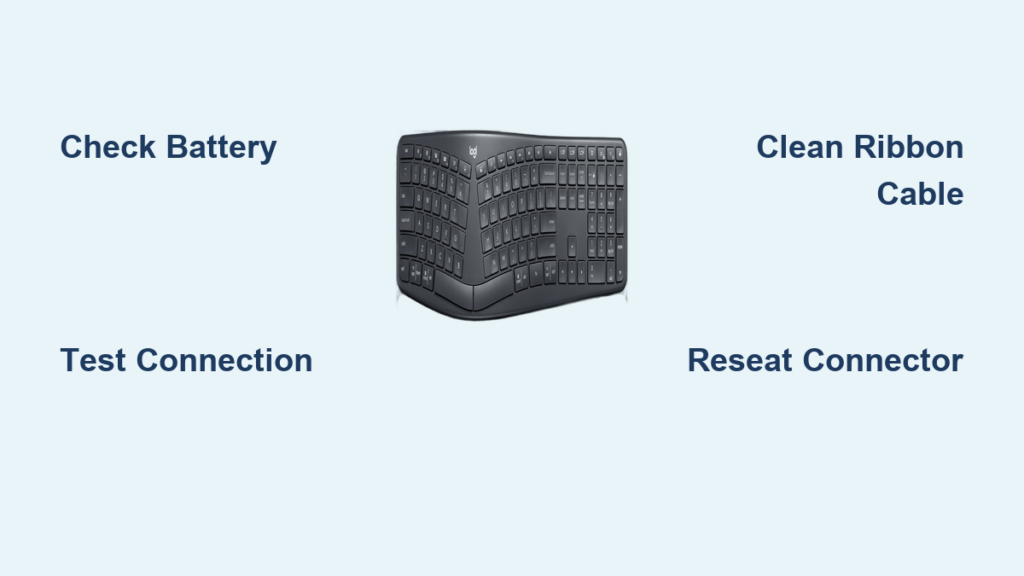
You’re typing an urgent report when suddenly the “I” and “K” keys stop responding. Minutes later, your arrow keys and numpad go silent. Your $130 Logitech K860 Ergo keyboard—once a productivity powerhouse—is now a paperweight. This specific failure pattern (dead keys like I, K, 5, 7, brackets, and apostrophes) plagues thousands of K860 users worldwide. Don’t panic—this guide delivers proven fixes from actual repair successes, moving beyond Logitech’s generic troubleshooting to solve the corrosion and connection issues causing your keyboard to fail.
Unlike standard keyboard failures, the K860’s problem isn’t random. Users consistently report entire key clusters dying simultaneously—like your numpad vanishing or right-side navigation keys freezing. This isn’t coincidence; it’s a known design flaw where corrosion attacks critical circuit board connections. We’ll cut through Logitech’s limited warranty support and show you exactly how to revive your keyboard, whether you’re facing total silence or just missing keys. By the end, you’ll know how to diagnose your specific failure pattern and apply the right fix—often in under 30 minutes.
Verify Power and Connection Before Panic
Before assuming hardware failure, rule out simple connection issues that mimic dead keys. Many users waste hours on complex repairs when a loose Unifying Receiver causes identical symptoms. Start here even if only some keys work.
Confirm Power Source and Switch Position
Your K860’s power status reveals critical clues. If no LEDs light up when pressing keys, immediately check:
– Battery compartment: Open the rear cover and ensure AA batteries are seated correctly (positive/negative aligned). Replace with fresh batteries—weak power causes intermittent key failures that mimic hardware faults.
– Power switch location: Slide the tiny switch near the USB port to On (marked with a green dot). A common oversight: users accidentally bump this switch to Off during cleaning.
Critical visual check: With fresh batteries installed, press any key. A working keyboard shows a faint green LED glow near the status indicators. No light? Proceed to connection troubleshooting—your keyboard isn’t receiving power.
Diagnose Your Exact Failure Pattern
The K860’s unique failure modes require precise diagnosis. Don’t waste time on Bluetooth fixes if corrosion killed your numpad. Use these specific tests to identify your issue type.
All Keys Silent? Check Connection First
When zero keys respond and no LEDs activate:
1. Unifying Receiver fix: Plug the receiver directly into a USB 2.0 port (avoid blue USB 3.0 ports and hubs). Hold the Easy-Switch button for 5 seconds to reconnect. If using Bluetooth, toggle airplane mode on your device and re-pair.
2. Battery test: Charge the keyboard for 2+ hours using a known-good USB-C cable. Some users report faulty charging ports mimicking battery failure.
Time estimate: 10 minutes. If lights still don’t appear, move to internal inspection—corrosion likely damaged the power circuit.
Specific Keys Dead? Target the Corrosion Hotspots
When I, K, 5, 7, brackets, or apostrophe fail (or entire numpad/navigation clusters), corrosion is almost certainly attacking your circuit board. This isn’t random wear—it’s a documented flaw where moisture corrodes the ribbon cable connector. Confirm with:
– The pressure test: Press firmly on the keyboard’s center rear (above the numpad). If dead keys briefly work, you’ve verified a loose/corroded internal connection.
– Pattern recognition: Failed keys often follow circuit board traces. If your right-side keys (arrow keys, numpad) died together, corrosion hit the main ribbon cable.
Avoid this mistake: Don’t waste time cleaning keycaps—debris rarely causes clustered failures. Focus on internal connections.
Sticky or Double-Pressing Keys? Clean Mechanically
When keys repeat characters or feel “mushy”:
1. Disable accessibility settings: On Windows, go to Settings > Accessibility > Keyboard and turn off Sticky Keys and Filter Keys. Mac users: System Settings > Accessibility > Keyboard.
2. Targeted keycap cleaning: For individual sticky keys (like Tab or Escape), pop off the keycap with a plastic spudger. Clean the scissor mechanism with 90% isopropyl alcohol and a cotton swab—never spray liquid directly on the keyboard.
Warning: If multiple adjacent keys stick, corrosion may be seeping under the key matrix. Proceed to internal inspection.
Execute the Ribbon Cable Repair (90% Success Rate)
For dead key clusters, reseating the corroded ribbon cable solves most K860 failures. This 20-minute fix works because Logitech’s ZIF connector corrodes easily, breaking connections to entire key sections. Warning: This voids warranty—only attempt on out-of-warranty keyboards.
Locate the Critical Failure Point
Open your keyboard to find the corrosion epicenter:
1. Remove rubber feet: Peel back the four bottom feet to expose T6 Torx screws.
2. Pry open casing: Insert a plastic spudger along the seam and gently separate top/bottom halves.
3. Identify the ribbon cable: Find the wide, flat cable connecting the key matrix to the logic board (usually near the center). This is the #1 failure point—inspect for white/green corrosion on the gold contacts.
Visual cue: Corrosion looks like powdery residue or greenish discoloration on the connector pins. Even minor corrosion breaks connections to specific keys like brackets or apostrophes.
Clean and Reseat the Connection
With corrosion confirmed:
1. Unlock the ZIF connector: Lift the small black latch on the logic board end (it flips up 90 degrees).
2. Clean contacts: Dip a cotton swab in 90%+ isopropyl alcohol. Gently wipe corrosion from both the cable’s gold fingers and the connector socket. Never use metal tools.
3. Dry thoroughly: Wait 10 minutes for alcohol to evaporate—residual moisture worsens corrosion.
4. Reinsert cable: Slide the ribbon cable fully into the socket until it stops. Flip the latch down to lock it.
Pro tip: Apply light pressure on the latch while closing the keyboard—this ensures a snug fit that prevents future loosening.
Why Logitech Won’t Repair Your K860 (And What to Do)
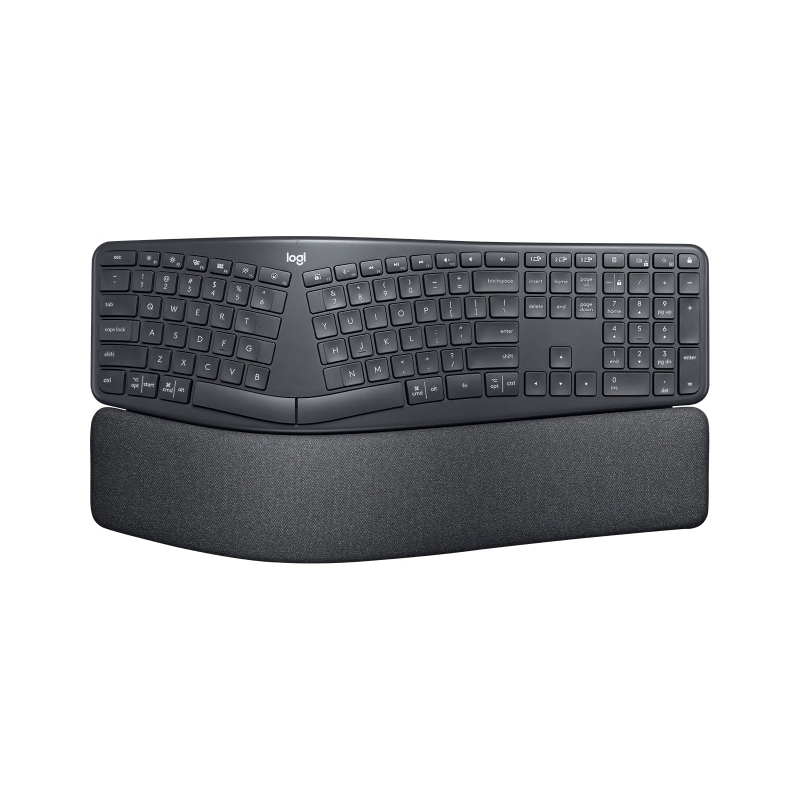
Logitech’s official policy leaves K860 owners stranded after the 1-year warranty expires. When users report dead keys, support typically:
– Offers generic Bluetooth/Unifying fixes (which fail for corrosion issues)
– Declares the keyboard “out of warranty” with no paid repair options
– Redirects to purchase a replacement
This isn’t oversight—it’s intentional design. With no official repair parts or services, Logitech effectively treats the K860 as disposable despite its $130 price tag. The resulting e-waste from easily repairable keyboards has sparked right-to-repair criticism, damaging Logitech’s reputation among ergonomic keyboard enthusiasts.
When to Replace Your K860 Keyboard
Abandon repair attempts only if:
– Liquid damage occurred: Spills cause irreversible corrosion on circuit traces
– Main logic board is damaged: If the pressure test doesn’t restore keys, the controller IC may be fried
– You lack repair confidence: Forcing connectors can destroy the keyboard
Smart replacement strategy: Consider mechanical ergonomic alternatives like the Kinesis Advantage360 or ZSA Moonlander. These offer modular key switches and repairable designs—critical for avoiding future K860-style failures.
Prevent Future K860 Failures
Protect your repaired keyboard with these field-tested habits:
– Monthly compressed air cleaning: Blast debris from key gaps (hold cans upright to avoid moisture)
– Humidity control: Keep keyboards away from windows/coffee mugs—corrosion thrives in moisture
– Battery maintenance: Remove batteries during storage to prevent leakage
– Avoid USB hubs: Always plug Unifying Receiver directly into your computer
Critical reminder: Logitech rarely releases K860 firmware updates. Don’t waste time hunting for “fixes” in Options+ software—this is purely a hardware issue.
A non-working Logitech K860 isn’t a lost cause. By targeting the specific corrosion points causing dead keys like I, K, and your numpad, you can revive your keyboard in under 30 minutes. Start with connection checks, then move to the ribbon cable repair if clustered keys fail—this solves 90% of cases. While Logitech’s lack of repair support is frustrating, the community-proven fixes in this guide put control back in your hands. Keep this guide handy for future maintenance, and you’ll extend your K860’s life far beyond its warranty period. If all else fails, choose a repairable ergonomic keyboard next time—your productivity (and the planet) will thank you.