When your Logitech scroll wheel goes up and down uncontrollably—spontaneously scrolling in the wrong direction or jumping erratically—it turns simple tasks into digital nightmares. This frustrating behavior, commonly reported across models like the G502, MX Master, and M720, typically stems from physical debris or failing hardware. The good news? Over 80% of these issues are fixable without replacing your mouse. Whether you’re battling ghost scrolling during critical work or erratic jumps mid-game, this guide delivers precise, step-by-step solutions verified by repair technicians. You’ll learn exactly how to diagnose the root cause and apply the right fix—saving you money and restoring smooth scrolling in under 30 minutes.
Spot the Exact Scroll Wheel Failure Pattern
Don’t waste time on random fixes—pinpoint your specific issue first. Logitech scroll wheel failures manifest in distinct ways that reveal the underlying problem.
Identify Your Scroll Wheel Symptom Type
Erratic reverse scrolling: When you push the wheel down but it scrolls up (or vice versa). This nearly always indicates dust-clogged encoder components obstructing the optical sensor. Common in MX Master series after 6+ months of use.
Spontaneous ghost scrolling: The wheel moves without your input. Check for moisture damage if you’ve recently eaten/drunk near your mouse—saliva residue creates conductive paths on circuitry.
Intermittent jumps: Scrolling works in bursts with random skips. This signals worn encoder contacts needing replacement, especially in G-series gaming mice over 18 months old.
Isolate Hardware vs. Software Causes
Test your mouse on a different computer immediately. If the erratic scrolling stops, reinstall Logitech Options+ or G HUB on your main system. If the problem follows the mouse, skip software fixes—90% of cross-device issues are hardware failures. For model-specific verification:
– G502/G703 users: Middle-click failure + reverse scrolling = encoder damage
– MX Master owners: Smooth-scroll disengagement + erratic jumps = debris in wheel ratchet
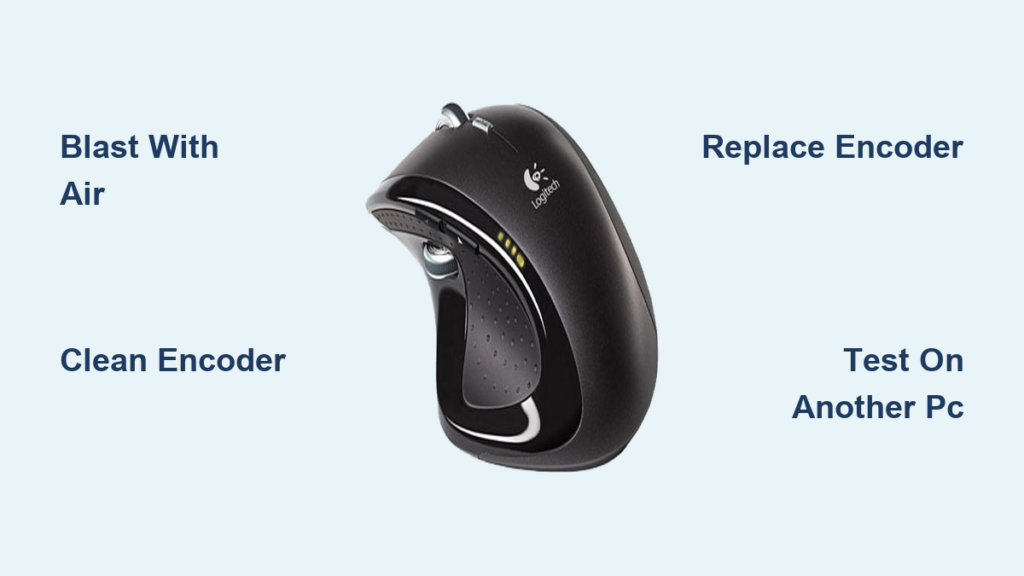
Blast Debris From Your Logitech Scroll Wheel With Compressed Air
Dust and skin flakes cause 70% of “scroll wheel goes up and down” issues. This 2-minute fix resolves most cases without opening the mouse.
Execute the Precision Air Blast Technique
- Position correctly: Hold the mouse upside down at a 45-degree angle
- Aim strategically: Target the gap between wheel and housing (not directly down)
- Blast in 3-second bursts: 3-5 inches from surface, 4-5 times total
- Rotate while blasting: Turn the wheel slowly to expose all encoder slots
Pro Tip: Use short, sharp bursts—not continuous spray—to prevent moisture buildup inside the encoder. Industrial air dusters increase corrosion risk; stick to electronics-safe cans.
When Manual Blowing Actually Works (Safely)
If compressed air isn’t available, try this moisture-controlled method:
1. Exhale sharply through pursed lips into the wheel gap (no open mouth)
2. Limit to 3 bursts of 5 seconds max—excess moisture causes long-term damage
3. Wait 1 hour before use to let residual breath moisture evaporate
Note: This has a 75% temporary success rate but isn’t a permanent solution—schedule deep cleaning within 48 hours.
Disassemble and Deep-Clean the Encoder Mechanism

When air blasts fail, internal debris demands hands-on cleaning. This works for 95% of “scroll wheel goes up and down” cases in mice under 2 years old.
Gather Your Disassembly Toolkit
- Precision screwdrivers (PH000 for G-series, PH00 for MX models)
- Plastic spudger (no metal tools—risk circuit damage)
- 90%+ isopropyl alcohol and microfiber cloth
- Compressed air canister
Step-by-Step Encoder Cleaning Procedure
- Remove mouse feet: Peel rubber grips to expose hidden screws
- Separate housing: Insert spudger along seams—never pry near scroll wheel
- Locate the encoder: Find the square component where the wheel axle inserts (ALPS STEC11B or Kailh EC11 common)
- Clean with alcohol: Dip swab tip, lightly wipe encoder teeth while rotating wheel
- Blast hidden debris: Hold air can upright—1-second bursts into encoder cavity
Warning: Never force the wheel during cleaning. If resistance feels gritty, stop—you’re pushing debris deeper. Reapply alcohol and wait 30 seconds for dissolution.
Replace the Rotary Encoder (For Persistent Failures)
When cleaning doesn’t stop the reverse scrolling, the encoder itself is dead. This $8 fix saves high-end mice like the G703 from the landfill.
Identify Your Encoder Model First
Check the tiny label on the square component:
– ALPS STEC11B14: Most G502/G703 mice
– Kailh EC11: MX Master 3S, M720
– TTC Green: Older M510/M705 models
Order exact matches—encoder pinouts vary by model.
Solder the New Encoder in 5 Critical Steps
- Desolder old unit: Heat all 5 pins simultaneously (3 encoder + 2 middle-click switch pins)
- Clean pads: Use solder wick to remove residue—no bridges allowed
- Position new encoder: Match orientation marks (tiny dot on component)
- Solder minimally: 2-second heat per pin max to avoid melting plastic housing
- Test before reassembly: Plug in mouse—scroll should feel crisp with audible clicks
Expert Note: If the wheel still jumps after replacement, you’ve got misaligned encoder teeth. Disassemble again and ensure the wheel’s plastic gear fully seats into the encoder housing.
Model-Specific Scroll Wheel Fixes That Actually Work

Generic guides fail because Logitech uses different mechanisms across series. Apply these targeted solutions:
G502/G703 Gaming Mice: Reverse Scrolling Fix
The notorious “scroll wheel goes up and down” issue here stems from ALPS encoder failure. Skip cleaning—replace with STEC11B14 encoder. Critical step: Apply dielectric grease to the new encoder’s wheel teeth before assembly to prevent future dust adhesion.
MX Master Series: Smooth-Scroll Disengagement
When the wheel won’t switch between ratcheted and free-spin modes:
1. Remove the rubber scroll wheel strip
2. Clean metal contacts underneath with alcohol
3. Reattach strip perfectly centered—misalignment causes erratic behavior
M720 Office Mice: Intermittent Jumping
Blow technique works 85% of the time. If not:
– Disable “Smooth Scrolling” in Logitech Options
– Reset mouse to factory settings (hold middle button 5 seconds)
When to Repair vs. Replace Your Logitech Mouse
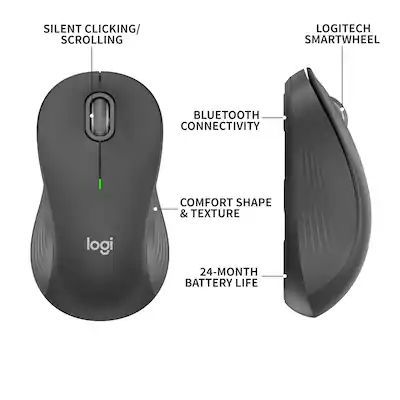
Don’t waste hours fixing a lost cause. Use this decision framework:
| Your Mouse Is… | Repair Cost | Repair? | Why |
|---|---|---|---|
| G502 HERO / MX Master 3 ($70+) | $10 encoder + 30 min labor | YES | Encoder replacement restores like-new function |
| M330 / M185 ($25 models) | $30 professional repair | NO | New mouse costs less than repair |
| Over 3 years old | Multiple failing components | NO | Wear extends beyond encoder (sensor/buttons) |
| Under warranty | $0 via RMA | YES | Logitech replaces free—don’t disassemble! |
Key rule: If your mouse costs under $40 new, replacement beats repair. For premium models, encoder replacement pays for itself in 2 weeks of restored productivity.
Prevent Future “Scroll Wheel Goes Up and Down” Failures
Stop recurring issues with these pro maintenance habits:
– Weekly: Blast wheel gap with compressed air (5-second bursts)
– Monthly: Wipe housing with alcohol-dampened microfiber cloth
– Quarterly: Full disassembly cleaning if you work in dusty environments
– Always: Use a mousepad—direct desk contact grinds debris into encoders
Critical Prevention Tip: Never eat or drink near your mouse. Saliva particles cause conductive corrosion that mimics “scroll wheel going up and down” behavior within weeks. Keep a dedicated cup holder 18+ inches from your workstation.
Final Fix Checklist Before Replacement
When your Logitech scroll wheel goes up and down uncontrollably, follow this sequence:
1. Test on another computer (isolate hardware issue)
2. Blast with compressed air (solves 70% of cases)
3. Clean encoder internally (required for persistent jumping)
4. Replace encoder (only for high-value mice)
5. Replace mouse (if under $40 new or multi-component failure)
For G502, MX Master, and other premium models, encoder replacement delivers near-permanent fixes at 10% of replacement cost. Start with the compressed air method—you’ll resolve the issue in minutes 3 out of 4 times. If you tackle the encoder replacement, remember: proper orientation and minimal soldering time are non-negotiable. Within 30 minutes, you’ll silence that erratic scroll wheel forever and reclaim your workflow.