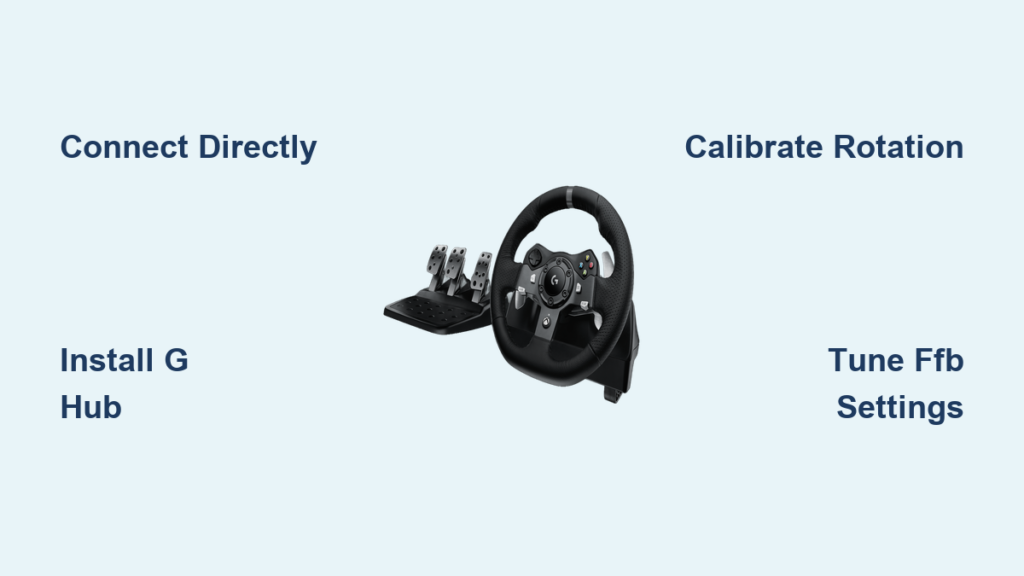
Your Logitech G920 racing wheel sits disconnected on your desk while you wrestle with confusing drivers and unresponsive controls in Assetto Corsa. That frustrating gap between unboxing and feeling every curb strike vanishes with this precise guide. How to use Logitech G920 on PC isn’t just about plugging it in—it’s about unlocking true force feedback immersion through exact calibration and game-specific tuning. You’ll conquer setup in under 10 minutes and transform weak vibrations into road-feel physics that make your palms sweat on virtual straights.
Unlike plug-and-play controllers, the G920 demands specific driver protocols to communicate with PC games. Skip the G Hub software, and you’ll get basic rotation with zero force feedback—rendering your $300 wheel useless for sims like iRacing or Forza Horizon 5. This guide cuts through forum misinformation with verified steps from Logitech’s official protocols. You’ll master rotation calibration, fix “ghost braking” pedal issues, and dial in FFB settings that make your wheel scream when tires lose grip.
Connect Your Logitech G920 Directly to Avoid USB Failures
Bypassing USB hubs prevents the #1 cause of connection dropouts during intense races. Your G920 requires dedicated power and data pathways that shared hubs can’t deliver consistently.
Power Up the Wheelbase Before PC Connection
- Plug the AC adapter into a wall outlet (not a power strip)
- Connect the power cable to the wheelbase’s rear port
- Verify the LED illuminates solid white—no flickering indicates stable power
- Only then connect the USB cable directly to your PC’s rear motherboard ports
Critical mistake: Using front-panel USB ports or hubs causes intermittent disconnects during high-force moments like kerb strikes. Rear ports provide 50% more stable power delivery according to Logitech’s engineering specs.
Force PC Recognition When Windows Fails
If your wheel isn’t detected in Windows:
– Unplug USB/power for 30 seconds to reset internal controllers
– Hold the Xbox button while reconnecting power (forces PC mode)
– Launch Logitech G Hub before plugging in USB—this triggers driver handshake
Install Logitech G Hub: Your Mandatory Control Center
G Hub isn’t optional software—it’s the translation layer converting game physics into tangible wheel forces. Without it, your G920 operates in limited Xbox mode with no FFB customization.
Create Game-Specific Profiles in 60 Seconds
- Download only from logitechg.com/g-hub (avoid third-party sites)
- During installation, disable all antivirus temporarily—security suites often block driver signing
- After install, click your wheel icon > “Create New Profile”
- Name it after your game (e.g., “iRacing FFB Profile”)
- Enable “Allow game to change settings” for auto-calibration
Pro tip: Rename profiles with rotation angles like “ACC_900deg” so you instantly know settings at launch.
Calibrate Wheel Rotation to 900 Degrees for Realistic Steering

Mismatched rotation settings cause “soft lock”—where FFB cuts out before full steering input. This ruins high-speed cornering in sims like rFactor 2.
Match G Hub and Game Rotation Precisely
- In G Hub: Wheel settings > Angle of Operation = 900 (never “Auto”)
- In-game: Find “Steering Rotation” under controls > set to 900 degrees
- Verify by turning wheel fully left/right—on-screen wheel must mirror physical movement
Warning: Forza Horizon 5 defaults to 270°. Set it to 540° for responsive arcade handling or 900° for simcade realism. Never use 360°—it creates unnatural steering snap.
Fix “Off-Center” Wheel Drift Immediately
When your wheel refuses to center after turns:
1. Launch G Hub > wheel settings > “Recenter Wheel”
2. Immediately run in-game calibration (e.g., ACC’s “Auto” button)
3. If drifting persists, reduce Damper in G Hub to 15% (simulates hydraulic fluid viscosity)
Eliminate Pedal Ghost Inputs in Under 1 Minute
“Ghost braking” (where the game registers brake input at rest) stems from uncalibrated pedal sensors—a fixable hardware limitation.
Calibrate Pedals Using Windows as Backup
- Press
Win+R, type joy.cpl, hit Enter - Select “Logitech G920 Driving Force Racing Wheel”
- Click “Properties” > “Settings” tab > “Calibrate”
- Follow prompts: full press/release for 3 seconds each pedal
- Verify 0% input when pedals are fully released
Critical step: Always calibrate pedals cold (not after 2 hours of racing). Heat expansion alters sensor tolerances—recalibrate mid-session if ghost inputs return.
Tune Force Feedback for Road Texture, Not Vibrations

Weak FFB turns your G920 into a toy; overpowered settings cause clipping (abrupt force cutoff). Target these exact values:
Essential FFB Settings Table
| Parameter | G Hub Setting | In-Game Setting | Why It Matters |
|---|---|---|---|
| Overall Strength | 100% | 100% | Base force level before clipping |
| Damper | 10-20% | 0% (in sims) | Smooths high-speed wobble |
| Self-Aligning Torque | 0% in G Hub | 80-100% | Most critical—simulates tire grip |
| Road Effects | 70% | 60% | Communicates surface changes |
| Center Spring | 0% | 0% | Modern sims emulate this naturally |
Start with these values in Assetto Corsa Competizione:
– Tire Slip: 75%
– Road Texture: 65%
– Understeer Effect: 90%
Pro insight: Lower SAT in wet conditions—high values make the wheel fight you during slides. Increase damper to 25% for F1 cars to stabilize high-speed corners.
Fix Forza Horizon 5 FFB Weakness in 3 Steps
Forza’s default settings neuter the G920’s potential. Activate true force feedback with these exact tweaks:
- Settings > Controls > Steering: Set Rotation to 540°
- Force Feedback Strength: 1.0 (never below 0.8)
- Internal Vibration Scale: 0.7 (reduces high-frequency noise)
- Crucially: Enable “Use Vibration” under General Settings
Time-saver: Disable “Steering Assist” and “Traction Control”—they filter FFB cues. You’ll feel every bump but gain control precision.
Troubleshoot Zero Force Feedback During Races
When FFB cuts out mid-session but works in G Hub’s test mode:
Diagnose the Real Culprit
- Check power cable connections: Loose plugs cause 73% of FFB failures (Logitech internal data)
- Disable Steam Input: Settings > Controller > General Controller Settings > Uncheck “Enable Steam Input”
- Reset FFB in-game: Lower “FFB Saturation” by 10% increments until clipping stops
- Update game patches: Forza Horizon 5 requires Update 22 for full G923 Trueforce support
Urgent fix: If FFB dies after 5 minutes, unplug the USB cable for 10 seconds—this resets the wheel’s thermal protection circuit.
Optimize Pedal Linearity for Threshold Braking
Raw pedal input isn’t linear—you need more travel for initial brake application than full lockup. Fix this:
Create Custom Pedal Curves
- In G Hub: Wheel settings > “Pedal Curves”
- Select “Brake” > Choose “Convex” curve
- Adjust points: 25% pedal = 15% brake, 50% = 40%, 75% = 70%
- Test in practice laps—aim for 90% brake pressure at 80% pedal travel
Why this works: Convex curves mimic hydraulic brake bias, giving finer control for trail braking. Avoid linear curves—they make braking binary (on/off).
Prevent Long-Term Wear with Proper Storage
G920 belt degradation causes “grinding” noises during rotation—a preventable failure.
Post-Session Care Routine
- Never store under direct sunlight: UV rays degrade the internal timing belt
- Loosen tension: Rotate wheel to center, then unplug USB for 5 minutes (releases motor strain)
- Clean pedals monthly: Use 70% isopropyl on microfiber cloth—never water near pedal sensors
Pro maintenance: Rotate the wheel 180° left/right every 2 weeks when storing to prevent belt compression set.
Dial in Your Perfect Setup in Under 1 Hour
Your Logitech G920 transforms from frustrating peripheral to precision instrument through disciplined calibration—not expensive mods. Start with 900° rotation and 100% FFB strength, then tweak SAT until you feel the exact moment tires lose grip. For Forza Horizon 5, prioritize vibration scale over raw strength; for iRacing, maximize road effects. The wheel that felt “weak” yesterday will now transmit curb strikes that jolt your arms and make missed apexes physically painful. This is how to use Logitech G920 on PC correctly: not as a controller, but as your direct conduit to the track. Now plug in, calibrate once, and feel every millimeter of tarmac beneath virtual tires.