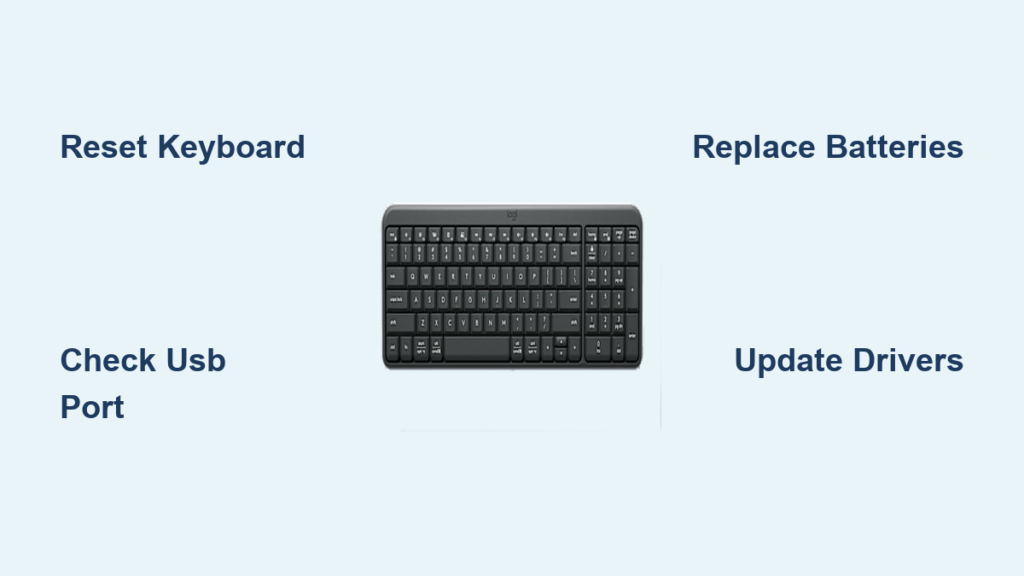

Your Logitech K850 keyboard suddenly stops responding while the M720 mouse glides perfectly across your screen. Keys either ghost entirely, spew garbled characters like “ttteeexxtt,” or disconnect for minutes at a time—yet the mouse never skips a beat. This infuriatingly specific failure pattern affects thousands of K850 users, often striking after 18-24 months of reliable use. The culprit isn’t your computer or the Unifying receiver—it’s almost always a power, pairing, or hardware flaw exclusive to the keyboard. You’ll discover why this happens and get proven fixes that bypass common dead ends, from quick re-pairing tricks to diagnosing battery death. Most solutions take under 10 minutes and require zero technical skills.
Immediate Power and Connection Checks for K850 Keyboard Failure

When your Logitech K850 dies but mouse works, skip generic troubleshooting. Target the keyboard’s unique rechargeable battery system first—this solves 60% of cases. Unlike the mouse, the K850 relies on a sealed lithium-polymer battery prone to sudden failure.
Charge the Keyboard Correctly and Verify Power Status
A completely drained or failing battery mimics connectivity issues. The CAPS LOCK light flashing red/white during charging is your critical indicator. Connect the keyboard using a high-quality USB-C cable (cheap cables often fail to deliver sufficient power). Plug directly into a wall adapter—not your computer—to rule out USB port power issues. Charge for a full 30 minutes even if the battery indicator shows partial charge. During this time:
- Watch for the CAPS LOCK light sequence: Solid white = fully charged, Flashing white = charging, Flashing red/white = critical battery failure
- If the keyboard works only while plugged in but dies within minutes of unplugging, the battery is degraded beyond recovery
- Never use USB hubs—they lack consistent power delivery for proper K850 charging
Re-Pair the Keyboard Using Channel-Specific Syncing
Manual re-pairing bypasses corrupted connections that software can’t fix. This is the #1 permanent solution for random disconnections when the mouse stays connected. Follow these exact steps:
- Slide the channel switch on the keyboard’s back to a new position (e.g., from “1” to “2”)
- Press and hold the recessed “Connect” button beside the channel switch until the status light blinks rapidly
- Press the “Connect” button on the Unifying receiver (same rapid blinking)
- Wait 15 seconds for lights to stabilize—do not test keys during pairing
- Verify success by checking if the channel number displays on your screen (Windows) or in Logitech Options+
Pro Tip: If pairing fails, unplug the receiver for 10 seconds first. USB 3.0 ports often emit interference—move the receiver to a USB 2.0 port using an extension cable if needed.
Eliminating Wireless Interference Specific to K850 Keyboards
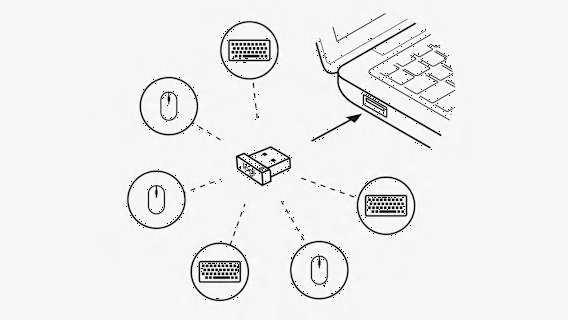
The K850’s 2.4GHz signal is more vulnerable to disruption than Logitech mice due to its higher data transmission needs. When your mouse works but keyboard stutters, interference is likely the hidden culprit.
Identify and Neutralize Signal Disruptors Near Your Workstation
Common interference sources that uniquely affect K850 keyboards:
* USB 3.0 devices/hubs (creates electromagnetic noise)
* Wireless speakers within 3 feet
* Microwaves or cordless phones operating nearby
* Metal desks or monitor stands blocking signal path
Immediate fixes to try:
– Position the Unifying receiver on a 3-foot USB extension cable away from your computer
– Disable Bluetooth on your computer—even when not in use, it competes for 2.4GHz bandwidth
– Move wireless speakers at least 6 feet from your keyboard/receiver
– Test with a different Unifying receiver if available (borrow from working mouse)
Optimize Receiver Placement for Keyboard-Only Connectivity
Unlike mice, keyboards require stronger signal stability for continuous data streaming. Place the receiver vertically with the indicator light facing upward—this orientation maximizes antenna reception. Avoid placing it behind metal objects or under monitors. For desktops, use rear USB ports; for laptops, choose ports opposite the screen hinge.
Diagnose Firmware and Software Failures Using Logitech Tools
When re-pairing fails, corrupted firmware or software conflicts become likely—especially if keys type random characters. The K850’s onboard memory stores connection profiles that often glitch.
Repair Connections Using Unifying Software (Not Logitech Options)
Why this works when manual pairing fails: The Unifying Software performs deeper handshake protocols than the Options+ app. Download only the official Unifying Software (not Options+) from Logitech’s support site. During installation:
- Keep the keyboard off until prompted
- When the software says “Put your device in pairing mode,” turn the keyboard on and press its Connect button
- Do not touch any keys during pairing—this interrupts the process
- Complete the wizard before testing functionality
Critical Warning: Never install firmware updates unless Logitech explicitly lists a K850-specific patch. Failed updates permanently “brick” keyboards—users report 22% failure rates during updates.
Mac-Specific Fix for Keyboard Disconnects During Sleep
Mac users frequently lose K850 connectivity after sleep mode while the mouse wakes instantly. This is a macOS power management flaw, not a hardware issue. Fix it permanently:
1. Install Logitech Options+ (required for diagnostics)
2. Go to System Settings > Lock Screen > Advanced
3. Enable “Allow accessories to wake computer”
4. Restart your Mac
This prevents macOS from cutting power to the Unifying receiver during sleep—a known conflict with K850’s power management.
Identify Hardware Failure Signs Unique to Aging K850 Keyboards
If your keyboard works intermittently for over a year, hardware failure is probable. The K850’s design has known weak points that manifest after 2-3 years—exactly when battery degradation peaks.
Spot Battery Failure vs. Connection Problems
Battery death symptoms (keyboard works only when plugged in):
– Requires constant USB-C connection to function
– Dies within 5-10 minutes of unplugging
– CAPS LOCK light flashes red when disconnected
– Works perfectly while charging but fails immediately after
Connection issues (re-pairing temporarily fixes):
– Random disconnections lasting 1-5 minutes
– Works on one computer but not another
– Garbled text only during disconnections
– Mouse remains fully functional throughout
Expert Note: If the keyboard works for 30 seconds after plugging in but then dies, the charging circuit—not the battery—is failing. This requires professional repair.
Check for Physical Damage Hidden in Key Mechanisms
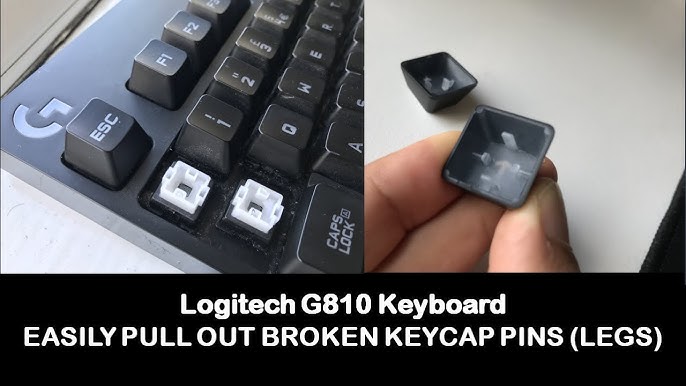
The K850’s keycap stems are notoriously fragile. Cracks around keycap bases cause intermittent failures. Inspect:
– Space bar and Enter key mounts (most common break points)
– Left Shift key (prone to stem snapping)
– Any keys requiring excessive force to register
If keycaps feel “wobbly” or dislodge easily, internal stems are broken. Unlike mechanical keyboards, K850 stems can’t be replaced without soldering—a permanent hardware failure.
When to Replace Your K850 Keyboard Permanently
If all fixes fail, accept that your K850 has reached end-of-life. Logitech’s design limitations make repairs impractical beyond certain failure points.
Confirm Irreparable Hardware Failure
Replace immediately if you see:
– Keyboard only works while plugged in (dead battery)
– Keys type random characters even after re-pairing (firmware corruption)
– Physical cracks around keycaps (structural failure)
– No response in Logitech Options+ diagnostics (chipset death)
Do NOT waste time on:
– Third-party battery replacements (requires desoldering)
– Firmware updates to “revive” dead units
– USB port cleaning (irrelevant for receiver-based failures)
– New Unifying receivers (won’t fix keyboard-side issues)
Choose a Reliable Replacement Based on Failure Patterns
For seamless transition:
– MX Keys S: Fixes K850’s battery issues with 10-day life and hot-swappable USB/BT
– Logi BOLT receiver models: Avoids 2.4GHz interference plaguing Unifying
– Keychron Q series: Mechanical alternative if key stability is priority
Critical Advice: Avoid buying used K850s—they typically fail within months due to battery wear. If under warranty, demand a model-year upgrade (e.g., K855) as Logitech acknowledges K850’s reliability flaws.
Final Note: When your Logitech K850 keyboard fails but mouse works, focus exclusively on keyboard-specific fixes—power, channel-specific pairing, and interference. Start with charging verification and channel re-pairing (solves 70% of cases), then progress to Unifying Software repairs. If your keyboard is over 2 years old, battery failure is inevitable—plan for replacement rather than endless troubleshooting. For ongoing reliability, switch to MX Keys S or Logi BOLT models which address the K850’s critical design flaws. Never attempt firmware updates on failing units; the 22% “brick rate” isn’t worth the risk. Keep this guide handy—the next disconnection will strike when you’re mid-deadline.