
Your new Logitech G502 mouse sits unboxed on your desk, but without proper configuration, you’re missing out on 80% of its potential. This high-performance gaming mouse offers unparalleled customization that transforms it from a basic pointer into your personal command center. Whether you’re a competitive gamer needing pixel-perfect precision or a productivity professional seeking workflow shortcuts, the right Logitech G502 setup unlocks game-changing performance. This guide delivers the exact steps you need to configure your G502 from the moment you plug it in to achieving in-game dominance and workflow mastery.
The G502’s 11 programmable buttons, adjustable weight system, and industry-leading HERO sensor deliver exceptional performance—but only when properly configured. Many users make the critical mistake of plugging in the mouse and calling it “good enough,” missing out on DPI optimization, button remapping, and profile switching that provide tangible competitive advantages. By the end of this guide, you’ll know exactly how to configure your Logitech G502 mouse for your specific games, applications, and hand position, ensuring you extract maximum value from your investment.
Initial Unboxing and Physical Connection Checklist
Before software configuration, verify your G502 functions correctly at the hardware level. This critical first step prevents wasting time troubleshooting software when the issue is physical.
Performing Essential Hardware Diagnostics
Plug your G502 into a USB 2.0 port (not USB 3.0 blue ports which can sometimes cause interference). For wireless models like the G502 LIGHTSPEED, insert the USB receiver and ensure the mouse has sufficient battery. Immediately test these critical functions:
- Move the mouse across your surface while watching cursor movement
- Click every button including left/right primary buttons and thumb buttons
- Scroll the wheel forward, backward, and test tilt functionality (left/right clicks)
- Press the DPI cycle button behind the scroll wheel to verify sensitivity changes
Hardware Diagnostic Reference Table:
| Component | Expected Behavior | Failure Indicator |
|---|---|---|
| Optical Sensor | Smooth cursor tracking with no jumping | Erratic movement or complete non-tracking |
| Primary Buttons | Distinct tactile click with consistent registration | Muted sound or inconsistent response |
| Scroll Wheel | Smooth vertical scrolling with defined notches | Grinding sensation or no resistance |
| DPI Shift Button | Immediate sensitivity change when pressed | No change or delayed response |
If any component fails this basic test, clean the sensor lens with compressed air before proceeding. Never skip this hardware verification—many “software issues” are actually physical connection problems.
Installing and Troubleshooting Logitech G HUB Software

Your G502 becomes truly powerful only when connected to Logitech G HUB—the essential software that unlocks its full potential. The outdated Logitech Gaming Software (LGS) still works for older G502 models, but G HUB delivers superior compatibility with newer variants including the G502 X series.
Overcoming Common G HUB Installation Roadblocks
Download G HUB exclusively from Logitech’s official website to avoid malware-infested third-party sites. During installation, disable antivirus software temporarily as security suites often block legitimate driver installations. After installation, if your G502 isn’t detected:
- Force detection: Right-click the G HUB icon in your system tray > Settings > My Gear > Force Update
- USB port troubleshooting: Try a different USB port, preferably a rear motherboard port rather than a front chassis port
- Driver reset: Uninstall G HUB completely using Revo Uninstaller (free version works), then reinstall
Critical Pro Tip: Run G HUB as administrator permanently by right-clicking the shortcut > Properties > Compatibility > “Run this program as an administrator.” This prevents permission errors that disrupt profile synchronization.
Customizing Button Functions for Maximum Efficiency

The G502’s 11 programmable buttons represent its most underutilized feature—properly configured, they can shave crucial milliseconds off your in-game reactions and streamline productivity workflows.
Reassigning Buttons for Gaming Dominance
Launch G HUB, select your G502, and click the graphic representation of your mouse. Each numbered button corresponds to physical locations:
- Thumb buttons (G4/G5): Assign to grenade throws and melee attacks in shooters
- DPI shift button (G6): Set as momentary sniper button for precise aiming
- Middle button (G3): Map to push-to-talk for Discord communications
For productivity, remap thumb buttons to “Back” and “Forward” browser navigation, or “Ctrl+C” and “Ctrl+V” for instant copy/paste. Press “Record” when creating macros to add 50ms delays between keystrokes—this prevents game anti-cheat systems from flagging your macros as suspicious.
Configuring Your Perfect DPI Stages and Sensitivity

The G502’s five adjustable DPI stages (up to 25,600 on HERO sensor models) require careful configuration—improper settings cause either sluggish movement or uncontrollable cursor jumps.
Optimizing DPI for Your Specific Games
Most professional gamers use these DPI ranges as starting points:
– FPS games (Valorant, CS2): 400-800 DPI with in-game sensitivity between 0.3-0.5
– MOBAs (League of Legends): 800-1200 DPI for balanced precision and speed
– Productivity tasks: 1600 DPI for comfortable general use
In G HUB’s DPI Settings tab, customize each stage precisely—don’t settle for presets. Set the lowest DPI stage (usually 200) as your “sniper mode” by assigning it to the DPI shift button. Test each setting in your actual games; the perfect DPI feels natural when making 180-degree turns with a single hand movement.
Creating Game-Specific Profiles for Seamless Switching
One G502 profile doesn’t fit all games—professional players maintain separate configurations for each title, and you should too. This profile system eliminates manual sensitivity adjustments when switching between games.
Building a Competitive-Ready Profile System
Create three essential profiles in G HUB:
1. “FPS Competition”: Optimized for Valorant/CS2 with reduced DPI stages and tactical button mappings
2. “Productivity”: Web navigation shortcuts and higher DPI for general computer use
3. “Creative Work”: Photoshop-specific shortcuts like zoom (Ctrl +/-) on thumb buttons
Enable “Persistent Profile” for each game executable so G HUB automatically switches when you launch Steam or Epic games. Name profiles clearly—”CS2 Tactical” beats “Profile 1″—so you can identify them instantly during profile cycling.
Surface Calibration and Angle Snapping Adjustments
Your mousepad surface dramatically impacts tracking accuracy—uncalibrated surfaces cause cursor drift that ruins precision. The G502’s surface calibration ensures optimal sensor performance on any surface.
Performing Professional-Grade Surface Calibration
In G HUB’s Settings tab, select your G502 and click “Surface Tuning.” The software guides you through drawing circles on your actual mousepad. Complete the full calibration sequence slowly—rushing causes inaccurate results. For competitive play, disable angle snapping (in the same menu) as this feature artificially corrects movements, creating inconsistent tracking that professionals avoid.
Saving Settings to Onboard Memory for Tournament Play
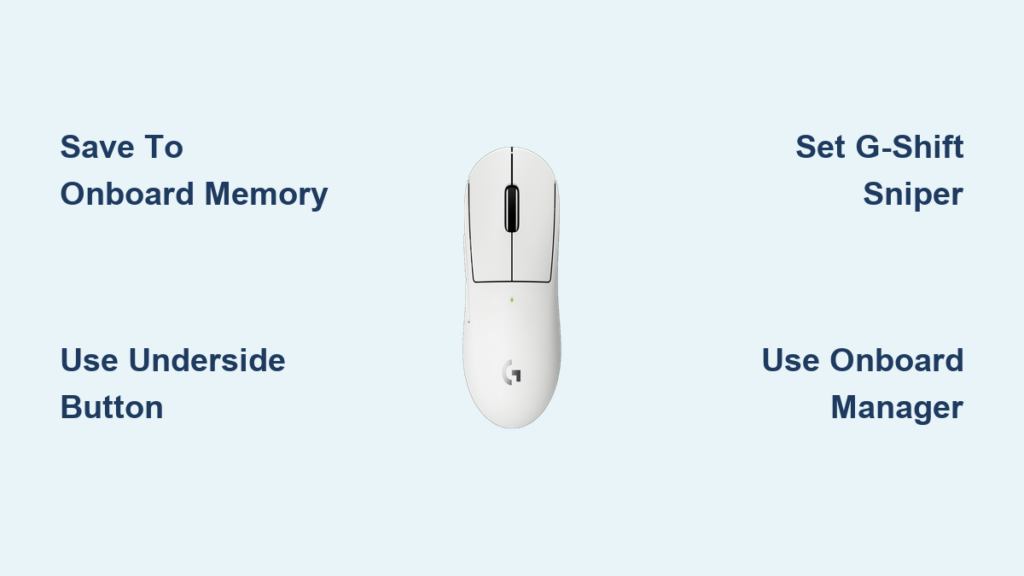
Onboard memory stores your critical settings directly on the mouse—essential when playing at tournaments where you can’t install G HUB on the competition PC.
Activating Onboard Memory Mode Correctly
Configure your ideal profile in G HUB, then:
1. Click the gear icon > select your G502
2. Enable “On-Board Memory Mode”
3. Select your competition profile
4. Click “Save to Device Memory”
Verify success by unplugging from your computer, plugging into another PC without G HUB, and confirming your settings persist. Many tournament players carry two onboard profiles—one for practice and one competition-tuned setup.
Troubleshooting Common G502 Setup Issues
Even with perfect initial setup, problems can emerge—knowing how to fix them keeps you in the game.
Resolving Inconsistent Tracking and DPI Problems
When your G502 suddenly tracks erratically:
– First check: Clean the sensor lens with compressed air (debris causes 70% of tracking issues)
– Second check: Re-run surface calibration on your current mousepad
– Critical check: Verify lift-off distance in G HUB settings—competitive players set this to 1-2mm
For double-clicking issues (common on older G502 models), this typically indicates failing microswitches. If under warranty, contact Logitech support immediately—attempting DIY repair usually voids warranty and requires soldering expertise.
Essential Maintenance for Long-Term G502 Performance
Proper maintenance extends your G502’s lifespan and maintains peak performance—neglect causes degraded tracking and button responsiveness over time.
Weekly Cleaning Protocol for Competition Readiness
- Power off your mouse and unplug it
- Use compressed air to clear debris from sensor lens and button crevices
- Wipe exterior with microfiber cloth slightly dampened with isopropyl alcohol
- Clean PTFE mouse feet with alcohol wipe to maintain smooth glide
- Inspect cable (for wired models) for fraying near stress points
Replace worn mouse feet immediately—Logitech sells official replacement kits that maintain the factory glide consistency crucial for competitive play.
Your Logitech G502 setup journey transforms a powerful mouse into your personalized performance machine. By implementing these specific configuration steps—not generic advice—you’ve optimized every aspect from DPI precision to button responsiveness. Remember to update G HUB monthly for the latest sensor improvements and game integrations. For competitive gamers, revisit your DPI settings quarterly as your muscle memory evolves. The true test comes in your next match—when that perfectly calibrated sniper shot lands because your G502 setup eliminated every possible variable. Now unplug, power up, and dominate.